Content:
- 1. Integrated vs. Co-Located: A Distinction That Matters
- 2. The Disciplines Under One Roof
- 3. Why Elite Sport Already Works This Way
- 4. What Integration Means If You’re a Clinician
- 5. What Integration Means If You’re an Entrepreneur or Operator
- 6. A Model Worth Seeing for Yourself
- 7. Frequently Asked Questions
Walk into most sports medicine practices and you’ll find one discipline doing its best to be everything: a chiropractic office that refers out for rehab, a physical therapy clinic that sends athletes elsewhere for recovery work, a massage practice operating in isolation from anyone managing the patient’s actual treatment plan. Each provider is competent. The system around them is fragmented.
Integrated sports medicine is the alternative — and it’s the model Alpha Sports Performance Medicine was built on. If you’ve read our recent articles on industry demand trends or the operator-owner model, you’ve seen us reference the multidisciplinary approach repeatedly. This article explains what it actually means, why it produces better outcomes for patients, and why it matters whether you’re a clinician evaluating ownership or an entrepreneur evaluating the business.
Integrated vs. Co-Located: A Distinction That Matters
First, a clarification, because the term gets diluted. Putting a chiropractor and a massage therapist in the same building is not integration — it’s co-location. The providers share a lobby and a lease, but the patient experience is still fragmented: separate intake, separate treatment plans, separate records, and no shared accountability for the outcome.
True integration means the disciplines operate as one clinical team. A single patient can move from chiropractic care into sports rehab, add recovery services between sessions, and consult with a dietitian — all coordinated under one treatment philosophy, with providers communicating about the same case. The patient doesn’t manage their own referrals. The clinic does.
That coordination is the product. It’s what patients can’t get by assembling their own roster of independent providers, and it’s what makes an integrated clinic genuinely different from the practices around it rather than just larger.
The Disciplines Under One Roof
The Alpha Sports Performance Medicine model brings together six core provider disciplines under one roof:
- Chiropractic care — the foundation of musculoskeletal assessment and treatment, and often the patient’s entry point into the clinic.
- Physical therapy — structured rehabilitation for injury recovery, post-surgical care, and the bridge between “cleared” and “competition-ready.”
- Massage therapy — soft-tissue work integrated into the broader treatment plan rather than offered as a standalone wellness service.
- Athletic training — injury prevention, movement screening, and return-to-play support.
- Nutrition and dietetics — nutrition guidance tied to the patient’s recovery and performance goals.
- Sports psychology — the mental side of injury recovery and athletic performance, which fragmented practices almost never address.
Those disciplines deliver a full menu of treatment and recovery services — from sports rehab and concussion screening to dry needling, shockwave treatment, soft tissue therapy, and recovery modalities — coordinated as one plan of care rather than sold as disconnected offerings.
No single discipline on this list is rare. What’s rare is finding all of them coordinated in one clinic, in one community, under one plan of care. For a closer look at how these service lines function as a business, see our article on how a sports medicine franchise generates multiple revenue streams. This article focuses on the clinical logic; that one covers the operational side.
Why Elite Sport Already Works This Way
The integrated model isn’t a marketing invention. It’s how care is delivered at the highest levels of sport, where outcomes are measured in medals and contracts and nobody tolerates fragmented treatment.
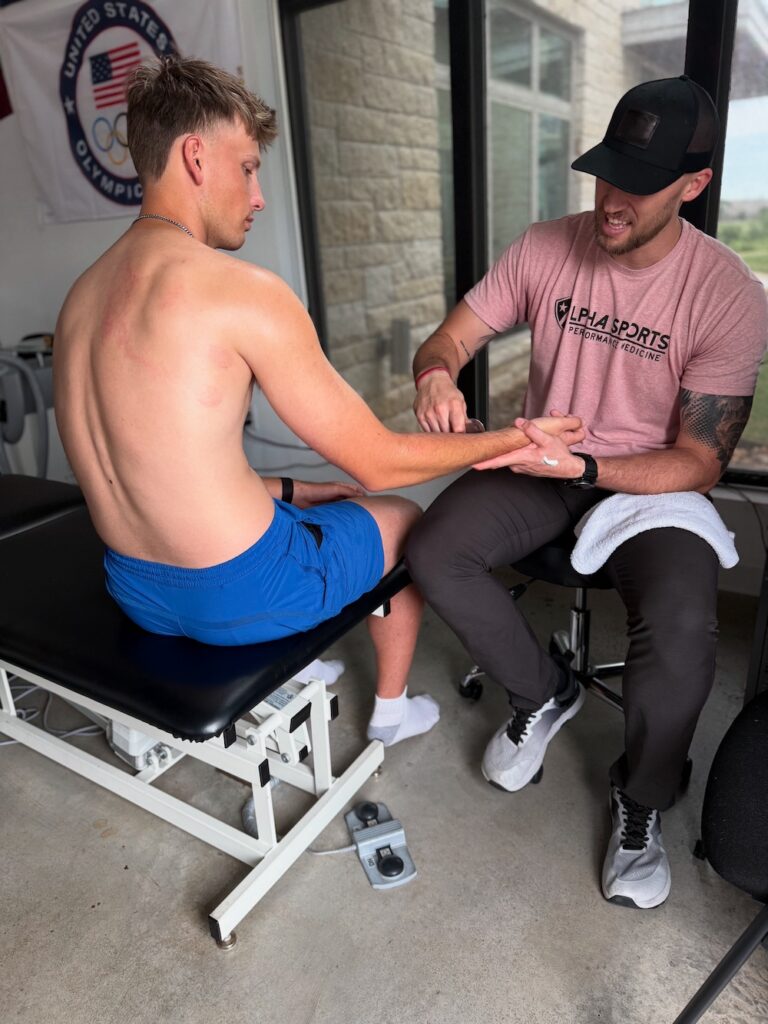
Dr. Ben Bumguardner, DC, CCSP, co-founder of Alpha Sports Performance Medicine, has served as a sports medicine provider for Team USA in Track & Field and Bobsled and at the CrossFit Games. In those environments, an athlete is never handed a referral slip and told to find their own physical therapist. Chiropractors, physical therapists, athletic trainers, dietitians, and sports psychologists work as a single staff around each athlete, because coordinated care returns athletes to competition faster and keeps them there longer.
Alpha Sports was founded to bring that standard of care out of the Olympic training environment and into local communities — serving not just elite competitors, but high school athletes, weekend warriors, and active adults who want the same coordinated approach. The flagship clinic in College Station, Texas is the proof of concept, and the franchise system exists to replicate it.
What Integration Means If You’re a Clinician
If you’re a chiropractor, physical therapist, or athletic trainer considering ownership, the integrated model changes your professional reality in three concrete ways.
You stop referring revenue — and patients — out the door. In a solo practice, every case that needs a service you don’t offer leaves your building. Some of those patients come back. Many don’t. In an integrated clinic, the referral happens down the hall, the patient stays in your system of care, and you maintain clinical visibility into the whole case. We explored the structural economics of this in our franchise vs. solo practice comparison.
You practice the way you were trained to think. Most clinicians learned to assess the whole patient, then entered practice models that confine them to one slice of treatment. Working alongside complementary disciplines restores the collaborative case management that drew many providers to sports medicine in the first place.
Your credential anchors the clinic. In the Alpha Sports model, clinical leadership isn’t an afterthought bolted onto a business plan — it’s the spine of the operation. We’ve written about why clinical credentials should drive your franchise decision; the integrated model is precisely where that credential does its heaviest lifting, because someone has to coordinate care across six provider disciplines, and that someone is a clinician.
What Integration Means If You’re an Entrepreneur or Operator
For investors and operators without a clinical license, the integrated model addresses the two structural questions any serious buyer should ask about a healthcare concept.
Differentiation you don’t have to manufacture. Most local healthcare businesses compete on convenience, price, or marketing spend, because the underlying service is interchangeable. An integrated multidisciplinary clinic competes on a care model that single-discipline competitors structurally cannot match without rebuilding their entire practice. That’s a durable position, not a promotional one.
Diversification inside a single roof. Six provider disciplines and a full service menu mean the clinic isn’t dependent on demand for any one of them. Patient needs shift across disciplines — an injury rehab patient becomes a recovery-services regular; an athletic training client adds nutrition support — and the clinic captures that movement instead of losing it to outside providers.
And critically, you don’t need to be the clinician to own the clinic. Alpha Sports’ operator-owner structure pairs business leadership with licensed clinical staff, with franchisor support covering the systems in between — a model we detailed in Can You Own a Sports Medicine Franchise Without Being a Clinician? State licensing requirements for clinic ownership vary, and the Alpha Sports team walks every candidate through how the structure works in their state.
A Model Worth Seeing for Yourself
Definitions only go so far. The integrated model is best understood by talking through how it operates day to day — how patients move between services, how the clinical team coordinates, and what the franchisor support system provides to make replication possible.
To start that conversation, visit our franchise opportunity page, email franchise@ASPMFranchise.com, or call (402) 852-5742.
Frequently Asked Questions
What is integrated sports medicine?
Integrated sports medicine is a care model in which multiple provider disciplines — such as chiropractic, physical therapy, massage therapy, athletic training, nutrition, and sports psychology — operate as one coordinated clinical team treating the same patient under a shared plan of care, rather than as separate providers connected only by referrals.
How is an integrated clinic different from providers sharing a building?
Co-located providers share space but not treatment plans, records, or accountability. An integrated clinic coordinates care across disciplines, so the patient experiences one continuous course of treatment instead of managing separate relationships with independent providers.
Do I need a medical or clinical license to own an integrated sports medicine franchise?
Not necessarily. Alpha Sports Performance Medicine supports an operator-owner model in which a non-clinician owner runs the business while licensed providers deliver care. Requirements vary by state, and the franchise team reviews the appropriate structure with each candidate.
What services does an Alpha Sports Performance Medicine clinic offer?
Alpha Sports clinics are built around six core provider disciplines — chiropractic care, physical therapy, massage therapy, athletic training, nutrition and dietetics, and sports psychology — delivering an integrated menu of treatment and recovery services, including sports rehab, concussion screening, dry needling, shockwave treatment, soft tissue therapy, and recovery modalities.Alpha Sports clinics are built around eight integrated service lines: chiropractic care, physical therapy, sports rehab, recovery services, massage therapy, athletic training, dietetics, and sports psychology.