
Content:
Most people researching a sports medicine clinic start with a more specific question than they realize. It isn’t “how do I open one” — that comes later. It’s “is sports medicine a growing industry, or am I buying into something that’s already peaked?”
That’s a fair question before you commit years and capital to any healthcare business. Here’s the good news: sports medicine sits inside one of the most durable growth stories in the American economy.
The more useful version of that answer gets into what growth actually means for you — and that depends entirely on whether you’re a licensed clinician or an entrepreneur looking to add another healthcare clinic to your portfolio. The data points the same direction for both groups; it just means different things depending on who you are.
Let’s dig into what the data shows about sports medicine growth, and why it has different implications for different audiences.
What the demand data actually shows
Look first to the U.S. Bureau of Labor Statistics, which publishes official employment projections for every major occupation from 2024 to 2034. Against an economy-wide average of 3 percent, healthcare and social assistance is expected to grow 8.4 percent — the fastest of any sector. The key drivers: an aging population and a higher prevalence of chronic conditions.
Drill into the occupations that staff a sports medicine clinic, and it’s the same story:
- Chiropractors are projected to grow 10 percent from 2024 to 2034 — more than three times the national average. The BLS ties this to demand for non-surgical, drug-free approaches to pain and to broad acceptance of integrative healthcare.
- Physical therapists are projected to grow much faster than the average for all occupations, driven by the aging population and the wider shift to non-opioid pain management. Physical therapist assistants and aides grow faster still, at 16 percent.
- Fitness and exercise trainers are growing faster than average too — 12 percent — which the BLS attributes to sustained public participation in organized fitness and performance training.
Here’s the bigger picture beneath those numbers: musculoskeletal disorders affect an estimated 1.71 billion people globally, and they rank among the leading causes of disability. Back pain. Joint injuries. Recovery from athletic injuries. Mobility loss. These don’t resolve on their own, and they don’t disappear during a recession. That makes sports medicine a needs-based category rather than a discretionary one — so the better question isn’t whether these clinics will keep growing, but how long the runway lasts.
The projections also reflect sustained, replacement-level demand rather than a one-time surge. Through 2034, the BLS estimates roughly 2,800 chiropractic openings and 26,400 physical therapist assistant and aide openings every year, both to fill new jobs and to replace workers who retire. Layer on a cultural shift: Americans of every age are starting to treat training, injury prevention, and recovery as normal parts of staying healthy — not something reserved for professional athletes. Rising youth-sports participation, recreational fitness, and older adults staying active later in life all feed a steady stream of patients through the door.
The demand doesn’t come from one demographic or one life stage. It’s reinforced across generations using clinics for different reasons: seniors protecting their joints, parents whose kids play sports, and office workers managing the toll of desk jobs.
Why these trends matter — and why they read differently to each audience
It’s good news that a category you’re evaluating is growing. It matters more to know what that growth means for you.
If you’re a clinician — a chiropractor, PT, or athletic trainer
You don’t need labor statistics to know the demand is there. You see it on your schedule. What you need is capacity. A solo practice or single-discipline clinic can only grow so far before your calendar is full — and then what happens when a patient needs treatment you can’t provide? That’s demand walking out the door to another clinic around the corner.
Think of it as the soft spot that rising demand exposes. Healthcare is moving toward integrated treatment whether your practice does or not — the BLS notes that chiropractors increasingly work alongside physicians and physical therapists through referrals and complementary care. A growing specialty only protects you if every specialty around it grows at the same pace. That’s the real trade-off between opening a clinic in your own discipline and joining one that brings several disciplines together.
If you’re an entrepreneur or operator
You may not read X-rays or diagnose shin splints. But you can read market data — and this slice of healthcare has the two qualities every operator looks for. It’s growing faster than the economy at large, and the demand behind it is inelastic. Nobody decides not to treat a hurt shoulder or chronic back pain because the economy is soft.
The natural follow-up — “shouldn’t I be a clinician first?” — misses a fundamental alternative: you can operate the business without being the one who writes the care plans. Under the operator-owner model, a non-clinician leads the business side while licensed clinicians handle care. We break down exactly what that looks like in our guide to the operator-owner model.
Two pieces of the same puzzle. Apart, they’re interesting. Together, they define a real opportunity at the intersection of what an owner can do and what patients need.
Why rising demand favors an integrated model
This is the insight many “is sports medicine growing?” articles miss. Growth is good. Concentrated growth is better.
Picture one patient: a recreational athlete with knee pain. They may need a chiropractor to assess joint function, a physical therapist to build a rehab program, a massage therapist for soft-tissue work, and someone to guide training load so they don’t re-injure it. Walk into a single-specialty clinic, and that’s four appointments in four different places.
Now picture all of it under one roof. In a fragmented model, the patient picks one service and collects referrals for the rest. In an integrated clinic, they get everything they need without hunting down specialists. Alpha calls that whole-person care. Every service line fills a specific gap — and brought together, they let a clinic carry more patients through to full recovery, then keep them coming back for sports physicals, annual check-ins, or simply to stay healthy.
Where Alpha Sports Performance Medicine fits
Industry data can tell you a category is growing. It can’t tell you whether a particular brand understands that category from years of working inside it — and that distinction matters more in healthcare than in almost any other field. The people staffing your clinic face your most important credibility test every day: does this care deserve a patient’s trust?
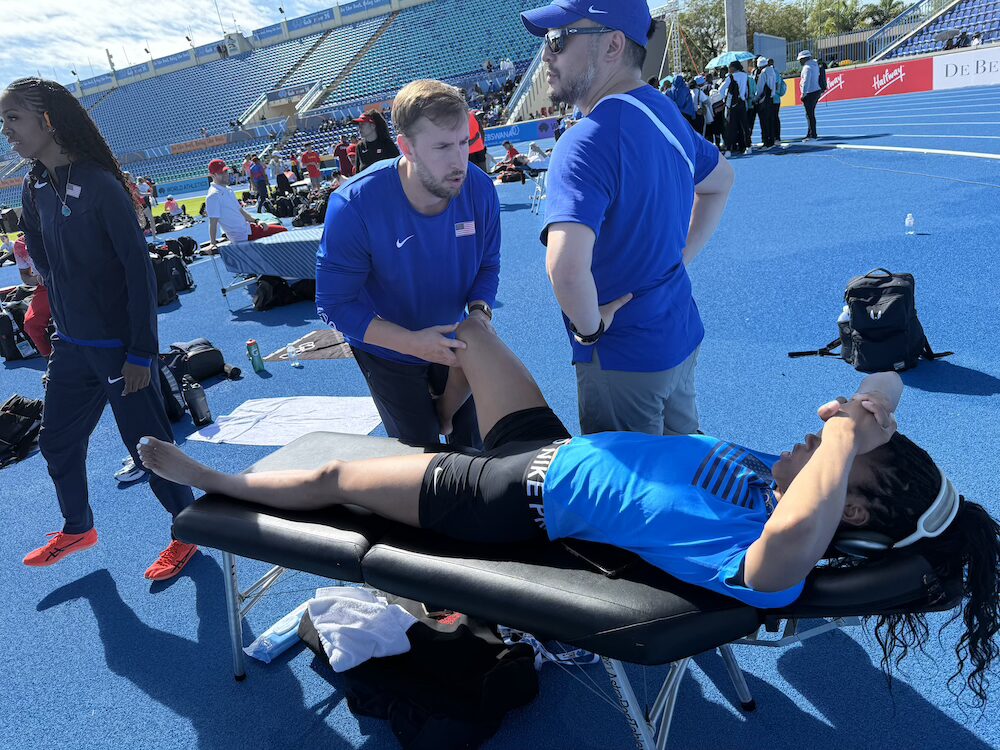
Alpha was co-founded by Dr. Ben Bumguardner, DC, CCSP, a sports medicine provider who has cared for Team USA athletes in Track & Field and Bobsled. If you’ve watched the Winter Olympics in the past decade, there’s a good chance he treated someone you saw compete. He also spent years working the CrossFit Games, where recovery and injury-prevention care are part of how athletes stay on the field. At that level, recovering well from an injury isn’t optional.
We bring that same standard to everyday communities. Walk into any Alpha location and you’ll find local athletes — and plenty of people who’d never call themselves athletes — being helped to train, recover, and stay at their best. Integrated clinics like this weren’t built to serve elite athletes. They were built by one.
Dr. Bumguardner’s background does more for Alpha than look good on a brochure. It’s the foundation that lets aspiring owners without a medical background step into a clinical business with confidence, and it’s what assures every patient who walks in that this team understands healthcare. If that resonates, we’d love for you to learn more about what Alpha offers aspiring owners.
What this means if you’re researching now
To recap: every profession that staffs a multidisciplinary sports medicine clinic is projected to grow much faster than the economy at large through 2034. The demand is rooted in long-term trends — an aging population that needs more care, a shift toward non-surgical pain management, and a culture that treats movement as part of health rather than just sport. Those forces don’t evaporate when one demographic has an off year.
For a clinician, that’s a way to grow past the ceiling of solo practice. For an operator, it’s a chance to own a resilient, needs-based business without being locked into a single specialty. For both, Alpha Sports is an opportunity to join an integrated, clinician-led franchise serving communities across Texas and beyond.
Have questions about ownership? Contact the Alpha Sports franchise team at franchise@ASPMFranchise.com or call (402) 852-5742.
Frequently asked questions
Is sports medicine a growing field?
Yes. The U.S. Bureau of Labor Statistics projects healthcare and social assistance to be the fastest-growing sector of the economy from 2024 to 2034. The professions inside a sports medicine clinic — chiropractors (10 percent), physical therapists (much faster than average), and fitness trainers (12 percent) — are all projected to grow well above the 3 percent all-occupations average.
Why is demand for sports medicine increasing?
Three durable forces: an aging population that needs more rehabilitation and mobility care, a healthcare-wide shift toward non-surgical and non-opioid pain management, and the sheer prevalence of musculoskeletal conditions, which affect an estimated 1.71 billion people worldwide. These are long-term trends, not fads.
Do you need to be a clinician to own a sports medicine franchise?
No. Under the operator-owner model, a non-clinician owns and runs the business while licensed providers deliver care. Alpha anchors its clinical authority in credentialed leadership, so entrepreneurs without a medical background can enter the category responsibly.
What professions are in demand in sports medicine?
Chiropractors, physical therapists and PT assistants, athletic trainers, massage therapists, and performance and fitness trainers are all projected to grow faster than the national average through 2034. An integrated clinic brings these in-demand disciplines together under one roof.
How is Alpha different from a single-specialty clinic?
Alpha integrates chiropractic care, physical therapy, massage therapy, athletic training, dietetics, and sports psychology into one coordinated team, so patients can be treated end-to-end rather than referred elsewhere. The model was built by co-founder Dr. Ben Bumguardner, DC, CCSP, drawing on his experience caring for Team USA athletes and at the CrossFit Games.