
Content:
- 1. What Olympic-Level Sports Medicine Experience Produces
- 2. How Dr. Bumguardner’s Background Shaped the Alpha Sports Model
- 3. Why Clinical Depth Translates to Patient Retention — and Revenue Stability
- 4. What This Means for Practitioners Evaluating Ownership
- 5. What This Means for Investor-Operators
- 6. Questions to Ask When Evaluating Any Sports Medicine Franchise
- 7. Conclusion
- 8. Frequently Asked Questions
Most sports medicine franchise presentations lead with the same elements: territory availability, estimated build-out timelines, projected revenue ranges, and marketing support infrastructure. Those details matter. But there is a category of due diligence that prospective owners frequently skip past — one that often has more bearing on long-term clinic performance than any of the metrics in a disclosure document.
That question is: who built the clinical model, and what have they done with it?
The clinical philosophy embedded in a franchise’s training, protocols, and service line design is the invisible architecture underneath every patient outcome, every referral source relationship, and every staffing decision the clinic makes. When that philosophy was developed under elite competitive conditions — tested against the highest standards of athletic care before it was ever packaged into a franchise system — it carries a different kind of depth than one assembled from industry best practices and a weekend seminar.
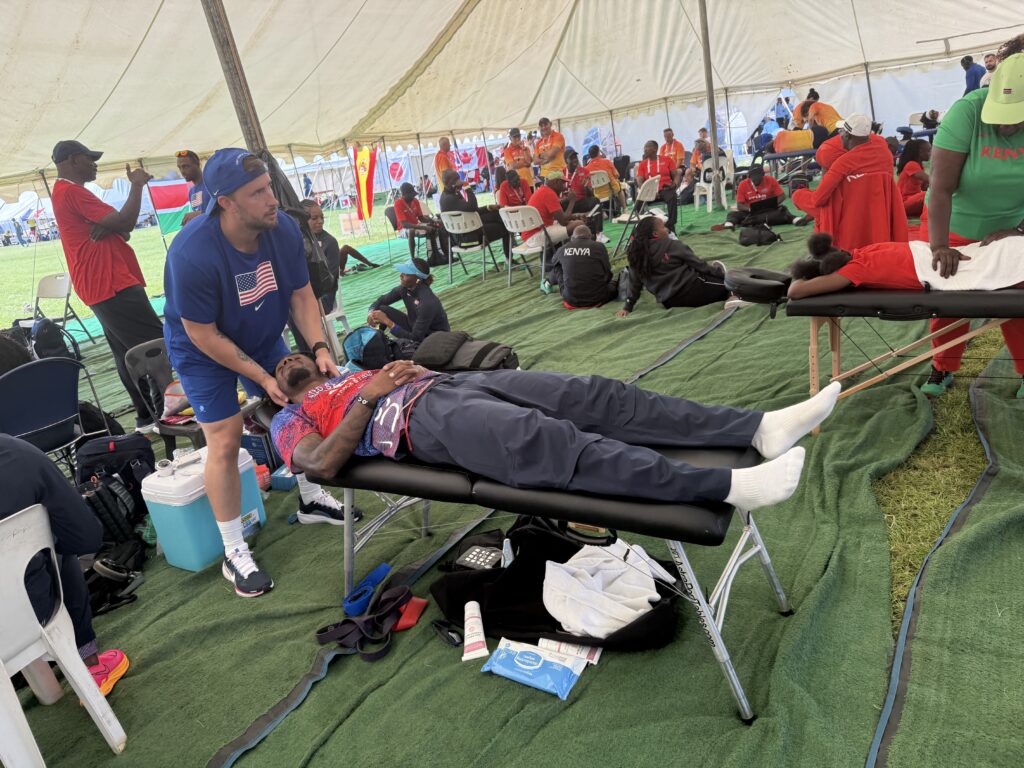
Alpha Sports Performance Medicine was founded by Dr. Ben Bumguardner, DC, CCSP. Dr. Bumguardner has served as a sports medicine provider for U.S. Olympic teams in track and field and bobsled, and has applied his integrated care approach at the CrossFit Games. The clinical model he developed at that level of competition is the same model he structured into the Alpha Sports franchise system.
This article is for two types of readers: licensed practitioners evaluating franchise ownership as a path to building their own clinic, and business operators or investors exploring healthcare franchises as a portfolio opportunity. For both, understanding what clinical leadership actually means in a sports medicine franchise is the foundation for making a well-informed decision.
What Olympic-Level Sports Medicine Experience Produces
Practicing sports medicine in an Olympic environment is operationally different from a standard outpatient clinical setting in ways that are not obvious from the outside.
Olympic and elite competition environments require providers to make high-stakes clinical decisions quickly, often without the diagnostic infrastructure available in a conventional clinic. Providers working at that level develop particular precision in assessment — identifying the source of dysfunction accurately, distinguishing what requires immediate intervention from what can be managed with load modification, and communicating those distinctions clearly to athletes performing under significant pressure.
They also become fluent across disciplines by necessity. An Olympic sports medicine provider does not work in isolation. They coordinate with coaches, physical therapists, athletic trainers, nutritionists, and sports psychologists. The integrated care model that elite sport demands is not a feature — it is a functional requirement. Providers who spend years operating in that environment learn to structure care holistically because outcomes depend on it.
When that experience becomes the foundation of a franchise clinical model, the effect is substantive. The intake processes, the treatment sequencing, the criteria used to determine when a patient transitions from one service to the next — all of it reflects a higher standard of clinical thinking than a model assembled primarily around billing optimization or service volume.
How Dr. Bumguardner’s Background Shaped the Alpha Sports Model
Dr. Bumguardner’s work at the U.S. Olympic level and at the CrossFit Games was not a side credential. It was the environment in which he developed and refined his clinical philosophy. The athletes he worked with had specific, measurable performance demands. The outcomes of his interventions were visible and accountable. That kind of accountability sharpens a clinician in ways that are difficult to replicate through coursework alone.
The Alpha Sports Performance Medicine franchise model reflects that development. The franchise is structured around an integrated service platform that includes chiropractic care, physical therapy, sports massage, dry needling, shockwave therapy, athletic training, and sports psychology — not as a collection of independent services sharing a square footage, but as a coordinated care ecosystem with defined handoff points and a shared clinical orientation.
This structure did not emerge from market research about which services were profitable. It emerged from the way Dr. Bumguardner learned to think about care: as a multidimensional process where performance, recovery, and long-term function are addressed together. The financial model follows the clinical model, not the other way around.
For franchise owners, this distinction matters. You are not licensing a brand name and a set of operational checklists. You are licensing a clinical model that was developed under real competitive pressure, with real athletes, at the elite level of the sport — and then methodically codified into a system that can be taught and replicated.
Why Clinical Depth Translates to Patient Retention — and Revenue Stability
The business case for a clinically sophisticated franchise model is straightforward, even if it is rarely framed this way in franchise development conversations.
Patients who receive fragmented, single-service care resolve their immediate complaint and move on. Patients who receive integrated, assessment-driven care — where the root cause of their dysfunction is addressed across relevant disciplines in a coordinated sequence — stay engaged in their care longer, experience more complete outcomes, and refer others who are looking for the same level of service.
In a sports medicine context, this dynamic is particularly pronounced. Athletes and active adults who find a provider that genuinely understands how their body functions under load — and can address that function across chiropractic, physical therapy, soft tissue, and performance disciplines — do not routinely shop for alternatives. They become loyal patients over time, and loyal patients generate revenue that is far more stable than the rotating new-patient acquisition cycle that single-service clinics depend on.
The integrated model embedded in Alpha Sports is not primarily a revenue diversification mechanism. It is a clinical philosophy that produces stable, multi-layered revenue as a downstream effect. Understanding that distinction matters for owners who want to evaluate the model honestly: you are not buying a revenue matrix. You are buying a patient experience model that generates that revenue because patients stay and refer.
What This Means for Practitioners Evaluating Ownership
If you are a licensed practitioner — a chiropractor, physical therapist, athletic trainer, or massage therapist — looking at franchise ownership, the clinical model behind the brand should be your primary point of evaluation, not your last.
The operational and marketing support a franchisor provides is meaningful. But the clinical direction of the franchise will shape your professional identity, your relationships with patients, and ultimately your daily experience as an owner-operator. Owning a franchise built on a clinical model you respect is a fundamentally different professional trajectory than owning one built around throughput and volume.
The Alpha Sports model was built by someone who spent years doing the hardest version of this work under conditions where results were measurable and immediate. For clinicians drawn to performance-focused, integrated care — and who want to build a practice that reflects that orientation — the model provides both the structure and the brand credibility to operate at a higher level than most independent clinics can independently achieve.
You also inherit the brand weight of Dr. Bumguardner’s credentials at the point of patient acquisition. In competitive markets for high-performing patients, that matters. Athletes and active adults who research their options encounter a franchise with a documented Olympic lineage. That is a meaningful differentiator at first contact and a meaningful retention signal once care begins.
What This Means for Investor-Operators
If you are approaching this as a business operator — someone who intends to own a clinic and install a qualified clinical director rather than practice yourself — the founder’s clinical credentials serve a different but equally important function.
The depth of the clinical model behind a franchise determines how well it can be codified, taught, and replicated. A model built on clearly articulated clinical principles, tested protocols, and defined service pathways is trainable. Your clinical director has a framework to operate within and develop from. A model assembled from general best practices requires more improvisation, which introduces variability in outcomes.
For investor-operators, clinical variability is a direct business risk. Inconsistent patient outcomes produce inconsistent referrals, inconsistent retention, and inconsistent revenue. A franchise system with a clinically rigorous foundation reduces that variability from the beginning of operations, not after a trial-and-error period.
The Alpha Sports franchise training and onboarding infrastructure is designed with this in mind. The systems provided assume that owners may not be practitioners themselves, and that the operational and clinical guidance provided needs to be thorough enough to support a qualified clinical team without the founder present. For a non-clinician owner, that depth of system design is not a convenience — it is a prerequisite for sustainable operations.
Investor-operators also benefit from the EEAT signal that Dr. Bumguardner’s background provides in digital patient acquisition. In an environment where AI-driven search features increasingly surface brands that demonstrate documented clinical expertise and real-world credentials, the Alpha Sports brand carries that signal without fabrication.
Questions to Ask When Evaluating Any Sports Medicine Franchise
Clinical credentialing is not something most franchise sales processes will surface unprompted. Here are the questions worth asking before you advance in any sports medicine franchise evaluation:
Who designed the clinical model, and what is their documented experience with performance populations? Look for verifiable credentials — board certifications, institutional affiliations, and demonstrated elite or professional sport experience. Not marketing language. Documented history.
Is the service model integrated or additive? An integrated model has defined clinical pathways between services and a shared philosophy connecting them. An additive model places multiple offerings under one roof without a coherent treatment framework tying them together. The difference in patient experience — and patient retention — is significant.
How is clinical training delivered to franchise owners and their staff? The quality of the training system reflects how well the clinical model is codified. Ask for specifics on curriculum, delivery format, and ongoing clinical development support.
What does the patient retention model look like? If the answer is primarily framed around new patient acquisition volume, ask more questions. Retention-driven revenue is more stable and reflects something real about care quality and patient outcomes.
For investor-operators: can the clinical director explain the model in clinical terms? If you are a non-clinician owner conducting serious due diligence, bring a clinical advisor to the evaluation process. Their read on the coherence and depth of the clinical model will tell you more than any financial projection in the franchise disclosure document.
Conclusion
Sports medicine franchising is a legitimate business opportunity in a growing market. The quality of what you are buying varies substantially based on what is underneath the brand — specifically, who built the clinical model and under what conditions.
Alpha Sports Performance Medicine was built on a clinical foundation that was stress-tested at the elite level — U.S. Olympic teams and the CrossFit Games — before it was structured into a franchise system. That lineage shapes every aspect of the model: how care is sequenced, how staff are trained, how patients are retained, and how the brand presents in a market that increasingly rewards demonstrated clinical expertise.
If you are a practitioner evaluating ownership, that foundation represents a clinical home worth a serious look. If you are a business operator evaluating a healthcare portfolio addition, it represents a system with the depth required to be replicated and operated reliably across locations.
The business model matters. But in healthcare franchising, the clinical model behind it matters more — and it is the first thing worth understanding.
To learn more about the Alpha Sports Performance Medicine franchise opportunity, contact the franchise development team at franchise@ASPMFranchise.com or (402) 852-5742.
Frequently Asked Questions
What credentials should a sports medicine franchise founder have?
At minimum, look for board-level licensure in a primary discipline — chiropractic, physical therapy, sports medicine, or athletic training — along with continuing education in sports-specific care and documented clinical experience with performance-focused patient populations. At the highest level of due diligence, look for verifiable experience working with elite or professional athletes, where the quality of clinical decision-making is held to measurable performance standards rather than symptom self-report alone. Dr. Ben Bumguardner, the founder of Alpha Sports Performance Medicine, holds the Certified Chiropractic Sports Physician (CCSP) designation and has served as a sports medicine provider for U.S. Olympic teams in track and field and bobsled, and has worked at the CrossFit Games.
Can a non-clinician own a sports medicine franchise?
Yes, in franchise models structured for investor-operators. These arrangements typically involve a business owner who manages operations and installs a licensed clinician as the clinical director responsible for patient care quality, licensure compliance, and staff clinical supervision. The viability of this arrangement depends on the franchisor’s training system and operational infrastructure — specifically whether the systems provided are thorough enough to guide a qualified clinical team without continuous founder involvement. Prospective investor-operators should evaluate the clinical director hiring process and the franchisor’s onboarding support as part of their due diligence.
What makes a sports medicine clinic different from a general chiropractic or physical therapy clinic?
A sports medicine clinic is distinguished by its performance orientation. The clinical focus is not only on resolving a presenting complaint but on restoring and optimizing physical function for patients who are active or athletic. In an integrated sports medicine model, this means combining chiropractic care, physical therapy, soft tissue modalities, and performance services under a coordinated care framework with a shared clinical philosophy. The intake process, treatment sequencing, and patient progression criteria are all designed with performance and recovery demands in mind — not symptom management alone.
How does franchising support a practitioner who wants to open a sports medicine clinic?
A franchise model provides the structural elements that are most difficult for an independent practitioner to build from scratch: brand credibility, clinical training protocols, operational systems, marketing infrastructure, and established vendor relationships. For a licensed clinician, this means the ability to focus on delivering care and building patient relationships without simultaneously constructing every business system independently. The tradeoff is operating within the clinical and operational framework the franchisor has established, which requires genuine alignment with the franchise’s care philosophy and standards.
Why does the clinical model matter to investors evaluating healthcare franchise opportunities?
In healthcare, clinical outcomes drive business outcomes more directly than in most other service industries. Patient retention, referral generation, and staff retention are all downstream effects of care quality. A franchise built on a clinically rigorous model produces more predictable outcomes — for patients and for the business — than one built primarily around service volume or billing optimization. For investors, this translates to more stable revenue, lower patient attrition, and a brand with a sustainable competitive position relative to single-service competitors and independent practitioners who cannot match the breadth or credentialing of an integrated model.